- The Last NORTH ATLANTIC Ocean Liners
- Last Ocean Liners to AFRICA & LATIN AMERICA
- To AUSTRALIA, FAR EAST & AROUND-the-WORLD
- SAILING SCHEDULES January to December 1966
- RANK & COMPARE the Last Ocean Liners
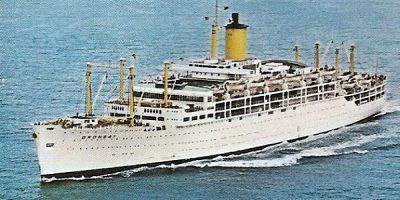
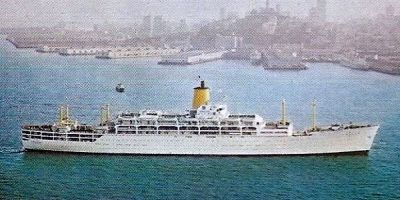
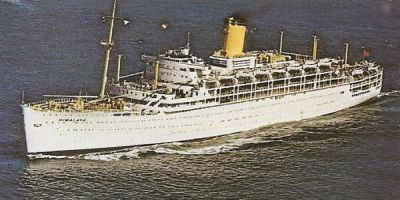
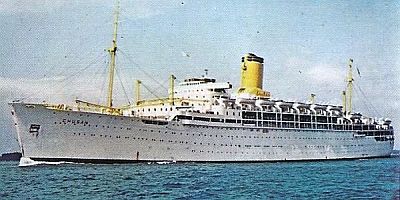
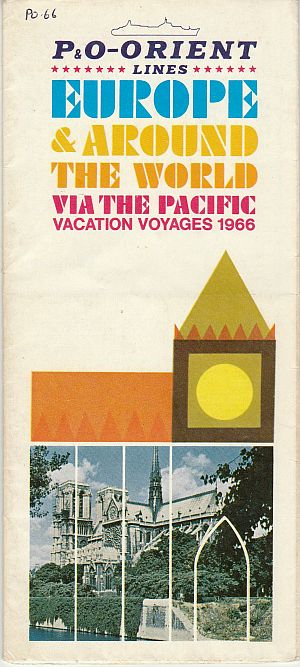 At the time of their 1960 merger, the combined P&O (Peninsular and Oriental) and Orient Lines had the largest fleet of passenger ships on earth. Most notable were the ocean liners built following World War II. Orient Line contributed the Orcades, Oronsay and Orsova, some of the most modern looking liners of their day. P&O added the Himalaya, Chusan, Arcadia and Iberia, which followed the popular design of their pre-war Strath class ships with few modifications.
Air travel was making its impact on the ocean liner, and so new ideas were needed to attract passengers to travel by sea. Accordingly, the seven newer ships were refurbished and refitted with complete air-conditioning. The distinctive corn colored hulls of the Orient liners were painted tropical white to match the P&O ships. Entertainment became a major feature of the voyage.
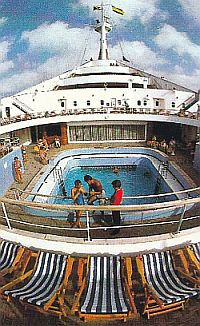 Next, the two biggest British ships since the Cunard Queens were placed in service. Oriana was the fastest ship ever built for the Australia run, cutting the sailing time from England from four weeks to three. The slightly larger Canberra followed a similar fast schedule. With aft mounted engines and nested lifeboats low in the superstructure, she was a trendsetter offering an unusual amount of prime space for passenger facilities. They were the largest ships yet built for a service other than the North Atlantic, and the last P&O-Orient ocean liners.
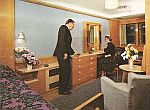
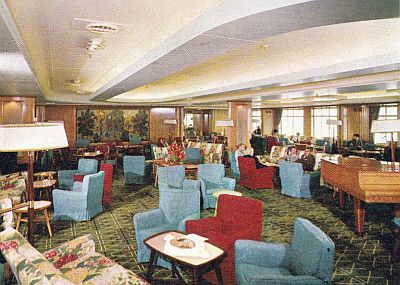 The interior layout of Arcadia was typical of the P&O-Orient liners. First class occupied the forward and midship areas, including an observation lounge on Boat Deck and the library, writing room, main lounge, cinema ballroom, verandah cafe and pool bar on Promenade Deck. First class staterooms were on A, B, C and D-Decks,
 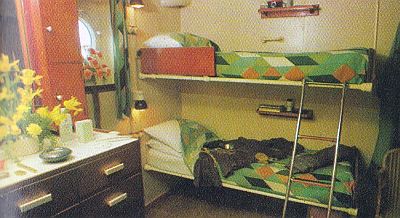 almost all with private bathrooms and many with two lower beds. Tourist class was located aft, with a gallery on A-Deck, dance space and verandah cafe on B-Deck and a lounge and smoking room on C-Deck. Cabins were 2, 4 and 6-berth without facilities on D, E and F-Decks. Each class had its own swimming pool on Promenade Deck and a restaurant on D-Deck.
 In 1961, to replace their older ships Corfu, Carthage and Canton on the six week run from Britain to Japan via Suez, P&O-Orient Lines purchased the Belgian combination liners Baudouinville and Jadotville, renaming them Cathay and Chitral.
By 1963, the last of the pre-World War II ocean liners were retired, including P&O's Strathaird, Strathnaver, Strathmore and Stratheden as well as Orient Line's Orion and Orontes. Himalaya and Orcades were then reconfigured as all tourist class, leaving P&O-Orient Lines with an all modern fleet.
 P&O-Orient Lines had created the greatest passenger ship network of all time, with their large liners calling at over 100 ports. Their main service linked Europe with Australia and New Zealand, with many sailings calling in India and the Far East as well. New routes sent P&O-Orient liners to the West Coast of North America (1954), Panama Canal and the Caribbean (1959) and Florida (1963). Their extensive cruise operation covered almost anyplace else the liner services missed. The Orient Line brand was phased out in 1966.
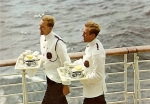
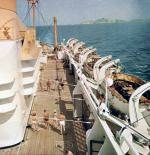 "You stretch out, relaxed, on a warm deck and suddenly, nothing on earth matters. You see the sun like you've never seen it before - dazzling across the smooth sapphire of the sea. And you discover how carefree life can be, surrounded by people who are actually eager to please you. You're in the world of P&O. And it's like nothing on earth!"
In the early 1970s, with the inevitable decline in point-to-point sea travel and a dramatic increase in fuel prices, P&O ceased most of its line voyages. First, the Cathay and Chitral were transferred to a P&O subsidiary in 1970 for further service between Australia and the Far East. Then they quickly retired and scrapped Iberia, Orcades, Chusan, Orsova, Himalaya and Oronsay. The Arcadia was used for both cruising and line voyages until 1979. That left only Canberra and Oriana, which were redeployed as full-time cruise ships.
Sample minimum one-way fares from Southampton to Sydney: First class $840; Tourist class $518; from Southampton to Yokohama: First class $934; Tourist class $583; from San Francisco to Southampton: First class $560; Tourist class $439; from San Francisco to Sydney: First class $504; Tourist class $405; All fares are per person in U.S. dollars.
Go to P&O-Orient Lines sailing schedules or select schedules by ship below:
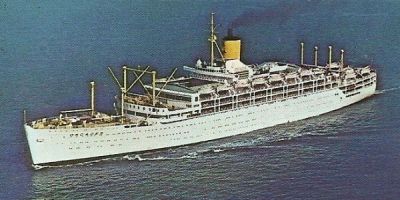 Orcades Built: 1948 by Vickers-Armstrongs, Barrow, England Go to sailing schedules for this ship. |
 Oronsay Built: 1951 by Vickers-Armstrongs, Barrow, England Go to sailing schedules for this ship. |
 Orsova Built: 1954 by Vickers-Armstrongs, Barrow, England Go to sailing schedules for this ship. |
 Himalaya Built: 1949 by Vickers-Armstrongs, Barrow, England Go to sailing schedules for this ship. |
 Chusan Built: 1950 by Vickers-Armstrongs, Barrow, England Go to sailing schedules for this ship. |
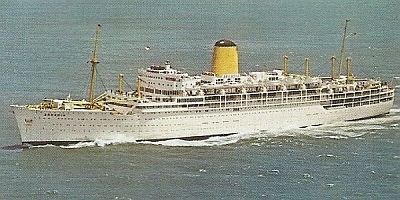 Arcadia Built: 1954 by John Brown & Co, Clydebank, Scotland Go to sailing schedules for this ship. |
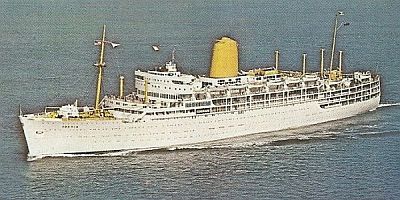 Iberia Built: 1954 by Harland & Wolff, Belfast, N Ireland Go to sailing schedules for this ship. |
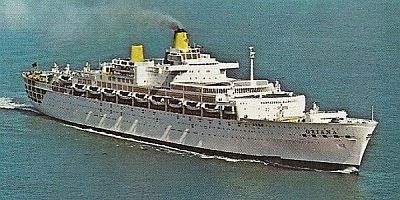 Oriana Built: 1960 by Vickers-Armstrongs, Barrow, England Go to sailing schedules for this ship. |
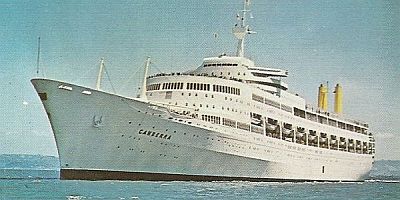 Canberra Built: 1961 by Harland & Wolff, Belfast, N Ireland Go to sailing schedules for this ship. |
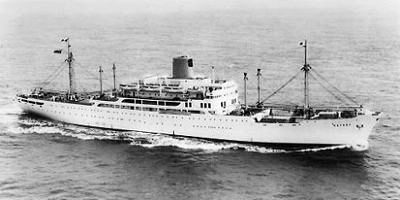 Cathay Built: 1957 by Cockerill, Hoboken, Belgium Go to sailing schedules for this ship. |
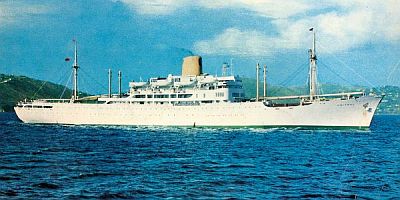 Chitral Built: 1956 by Penhoet, St Nazaire, France Go to sailing schedules for this ship. |